Defining the Right Scope for Business AI Automation
Define the scope of business AI automation with clear integrations, human approvals and acceptance criteria to compare proposals and invest confidently.
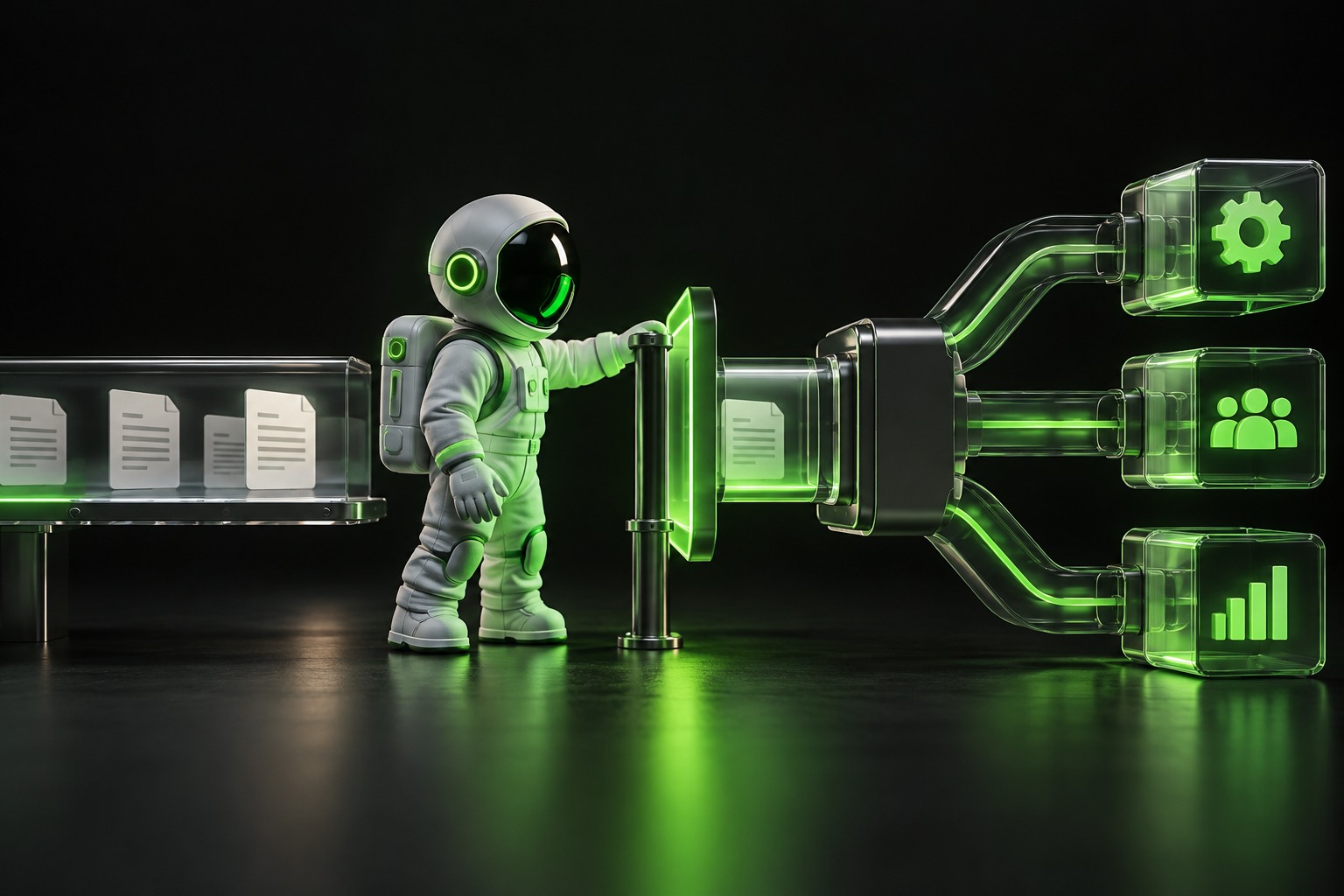
What is a sensible scope for your business automation?
The right scope for business AI automation covers a recurring workflow with an outcome that can be verified. The aim is not to hand every task to AI, but to connect steps that require reading, classification or drafting with your existing systems. That requires a clearly defined trigger, expected output and accountable owner.
For example, reading a website inquiry, classifying its service requirements and transferring it to a customer relationship management system can form one coherent scope. Setting a quotation amount or sending a binding response to the customer is a separate authorization decision. This distinction prevents a seemingly small automation from quietly taking control of the entire sales process.
Does every step need AI?
No; conventional automation may be more suitable for steps governed by fixed rules, while AI can help with content that requires interpretation. Checking a form field, creating a record or sending a notification usually does not require a language model. Understanding a request written in free text or summarizing a long conversation are tasks where AI may add value.
In an inquiry-handling workflow, rules can validate required fields, AI can classify the message, and the system can route the record to the relevant team. When information is missing or contradictory, the workflow can request human review rather than proceed on an assumption. This limits model use to the steps that need it and makes errors easier to trace.
How should integrations and data access be restricted?
Automation should access only the data and actions required for its task. A system that summarizes an inquiry does not need permission to edit an entire customer history or delete records. Read and write permissions, service accounts and the location of activity logs should be agreed before implementation begins.
If data moves between a web form, email and a CRM, the scope should cover field mapping, duplicate handling and what happens when a connection fails. Relevant specialists should review which providers receive personal data, their retention terms and any applicable cross-border transfer requirements. Instructions embedded in incoming messages must not be treated as commands that change the system's permissions.
When should automation require human approval?
Actions that commit the business to a customer, create financial consequences or are difficult to reverse should be subject to human approval according to their risk. Initially, having the system draft a response can be a more controlled choice than allowing it to send one directly. The approval interface should show both the proposed action and the source information supporting it.
Human oversight means more than adding an approval button: the workflow must identify the reviewer, track pending work and define what happens to rejected output. Uncertain classifications, missing documents and failed connections need their own routing rules. The ability to stop automation and return to manual operations should be tested before launch.
What deliverables should a service proposal include?
An AI automation proposal should specify the process map, integrations, permission boundaries, test scenarios and responsibilities after launch. It should explain how model usage, third-party tools and maintenance will be charged separately from implementation. A working demonstration alone is not a sufficient handover for live operations.
Acceptance testing should use examples representing routine inquiries, missing information, duplicate records and system outages. Processing time, the proportion of outputs requiring correction and the need for human intervention should be compared with the existing process, with thresholds agreed in advance according to business risk. When discussing a project with tingdea, you can map where website inquiries need to go and which decisions should remain with your team, planning automation as a connected workflow rather than a tool detached from your web experience.
Got a project on this topic?
Write to us