Where Should Business AI Automation Start?
Choose the right business workflow for AI automation, then define data readiness, human approvals, integrations and success measures before you invest.
Which workflow should you automate first?
The best starting point for business AI automation is a recurring workflow that creates a noticeable workload and produces outputs people can readily check. The first project does not need to transform an entire department; a bounded task such as classifying website enquiries can provide a more practical starting point.
Compare candidate workflows by frequency, time spent, data availability and the consequences of errors. Frequent tasks with easily reversible mistakes should generally be considered before financial or legal decisions that are difficult to undo. If the workflow has no owner or performance baseline, establish those first.
Does every automation need AI?
No; tasks with clear rules and structured inputs can often be handled by conventional automation. AI is more useful for steps that require interpretation, such as understanding free text, extracting information from documents or drafting responses.
For example, transferring a form submission into a customer relationship management system does not require AI. Identifying the service requested in the enquiry and preparing a summary for the relevant team may benefit from it. Designing around this distinction reduces unnecessary model usage and makes it easier to trace errors to a specific step.
How can incoming website enquiries be processed?
AI can classify and summarise website enquiries so they reach the right person. In a service business, for example, the system might suggest whether an enquiry concerns web design, SEO or brand identity; the team then checks that suggestion before preparing for a conversation.
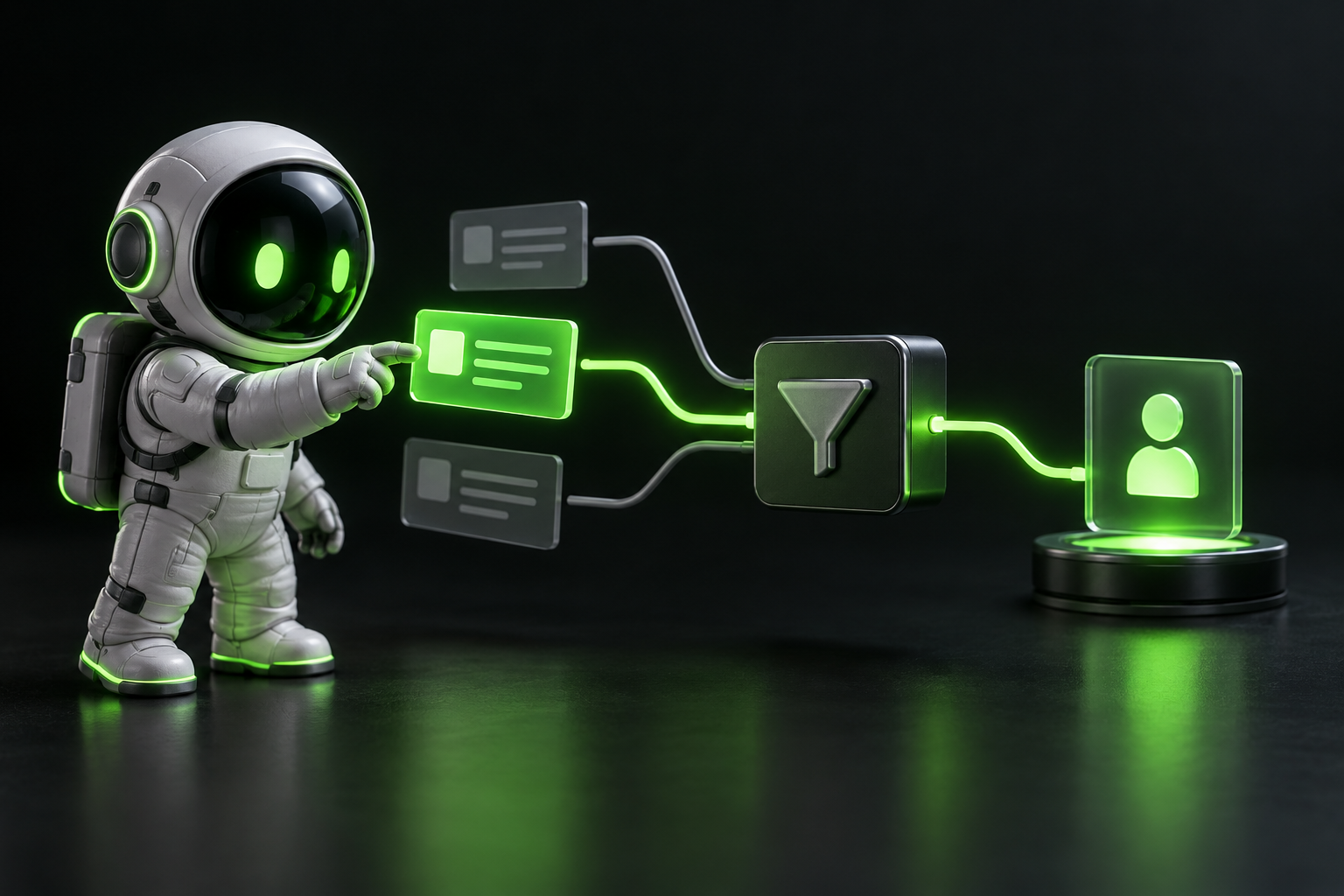
A practical workflow starts with form-field validation, followed by text analysis, record creation and a team notification. Incomplete or ambiguous enquiries should enter a separate review queue, while retries and alerts should help prevent records from being lost when connections fail. Automated classification should not, on its own, determine whether a prospect is rejected or a price is promised.
Where should data access and human approval be limited?
AI should receive access only to the data needed for its task, while actions with external consequences should have approval controls proportionate to their risk. Summarising an enquiry and taking action on a customer's behalf should not carry the same permissions.
Customer messages and uploaded documents should be treated as untrusted content; instructions within them must not change the system's permissions. Before implementation, establish which providers receive personal data, where it is stored and when it is deleted. Steps involving contracts, payments or sensitive customer communications should have human approval and a defined route back to manual processing.
How should the pilot be evaluated?
A pilot should be judged by changes in total workload and the impact of errors, not simply by the number of tasks completed automatically. Record handling time, correction needs and response time before starting, then compare the same measures across similar tasks after the pilot. Include the time spent reviewing outputs and fixing mistakes.
A service proposal should clearly define the workflow map, integration scope, test scenarios, usage costs and maintenance responsibilities. When considering tingdea's web design and AI automation services together, start by scoping one workflow from the website form through to team follow-up. Expand only if the pilot meets agreed quality and time-saving criteria; otherwise, revise the problematic step or return it to rule-based processing.
Got a project on this topic?
Write to us